
Supporting WinnerMeta
We rely on ads to keep the servers running.
Please disable AdBlock or Become a Supporter for an ad-free experience.
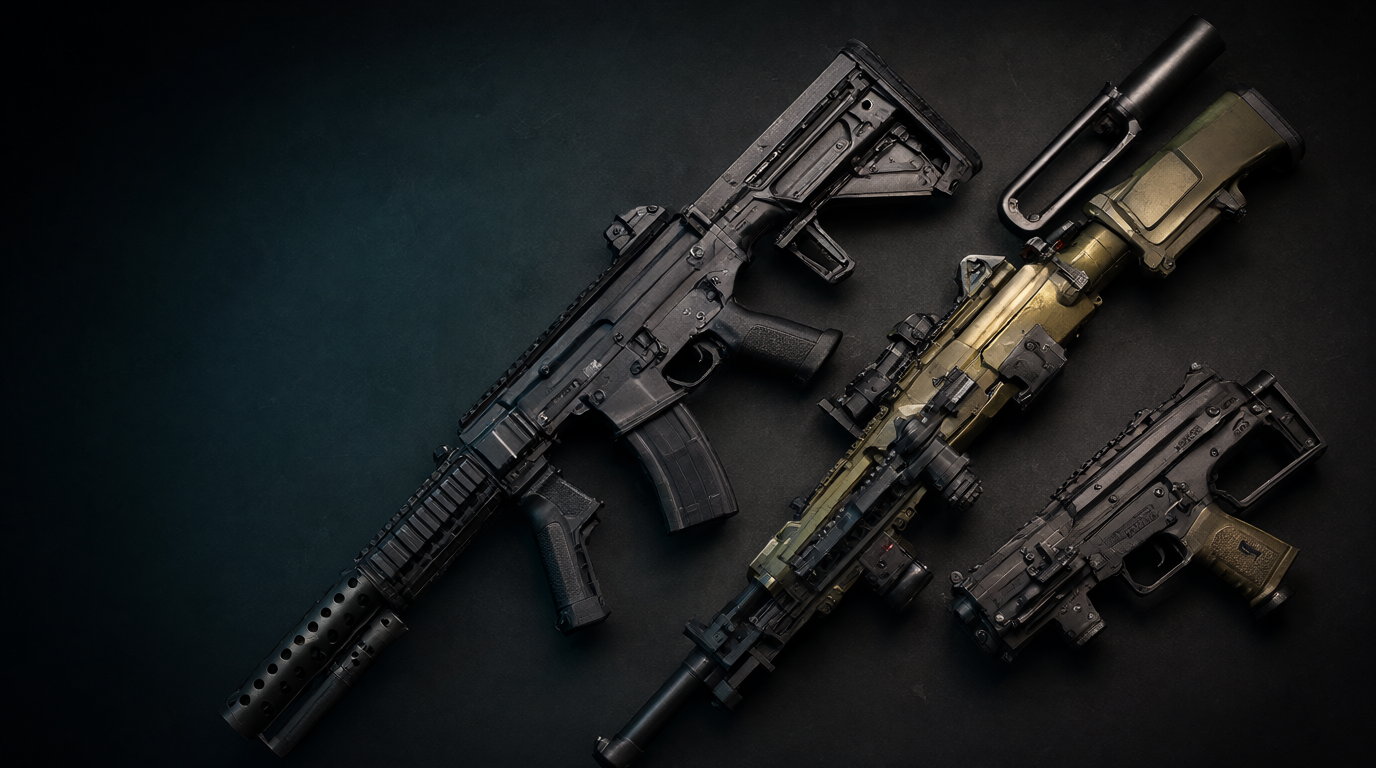
PUBG Attachments That Actually Matter: Grips, Stocks & Muzzles
An attachment does not turn a bad fight into a good one. It does make the rifle in your hands easier—or harder—to use for the fight you are about to take.
The useful question is not “which attachment has the highest stat?” It is: which attachment solves the next problem my weapon will have? Recoil control, first-shot stability, muzzle flash, sound, reload rhythm, or long-range precision all matter in different situations.
WinnerMeta’s attachment pages compare real match telemetry across compatible weapons. Use them as evidence, not as a universal tier list: players choose attachments for different weapons, ranges, and roles, so a higher rate is an association—not proof that the attachment caused the result.
Start with the weapon and the range
Before comparing attachments, decide what the gun is doing in your loadout.
- A full-auto AR used for repeated 30–80m sprays needs controllability first.
- A DMR or SR used for deliberate long-range shots benefits more from a stable, clear follow-up shot.
- An SMG used indoors rewards quick target acquisition and a setup you can handle under pressure.
That sounds obvious, but it prevents the usual mistake: taking a technically good attachment that does not fit the next fight.
Muzzles: choose the trade-off you will notice
For rifles, the compensator is the practical default when your goal is to keep a spray manageable. It is also the most common AR muzzle in WinnerMeta’s recent telemetry sample, with more than 1.17 million recorded shots. That popularity makes sense: vertical and horizontal control are immediately useful when you need multiple shots on one target.
A flash hider is a balanced choice when reducing visible muzzle flash matters without giving up all of the control-oriented feel. A suppressor gives up some of that obvious recoil help in return for less audio and visual information for opponents. It is strongest when your position, timing, and ability to stay untraded matter more than winning a long spray by a few bullets.
For DMRs and SRs, the choice is more situational. Recent WinnerMeta data shows large samples for compensators, flash hiders, and suppressors across long-range weapons. Do not read their accuracy or kill rates as a direct ranking: the shooter, weapon, and engagement distance differ. Instead, test the muzzle on the exact weapon you carry most often, then review whether your follow-up shots and finishes improve.
Quick rule: compensator for control, flash hider for a middle ground, suppressor for concealment and timing.
Grips: do not pick by reputation alone
Grips change how a weapon behaves while you are actually trying to track a target. That makes them one of the most personal attachment slots in PUBG.
WinnerMeta’s recent high-volume grip data includes Tilted Grip, Vertical Foregrip, Half Grip, Lightweight Foregrip, and Thumb Grip. Tilted and Vertical Foregrips each appear on more than 900,000 recorded shots in the current sample—evidence that neither is a niche answer.
Use the grip to fix a specific issue:
- Vertical Foregrip: start here if vertical climb is what breaks your spray.
- Half Grip: a good all-round option when you want a more aggressive full-auto feel and can manage the trade-offs.
- Thumb Grip: useful when faster handling and a responsive aim feel fit your style.
- Angled/Tilted Grip: worth testing if your problem is keeping a moving spray on target rather than only pulling straight down.
- Lightweight Foregrip: better suited to controlled, deliberate follow-up shots than panic spraying.
The best grip is the one that gives you a repeatable correction. If you keep losing the last third of AR sprays, use a grip that helps you hold that section—not the one with the most impressive-looking aggregate rate.
Stocks and cheek pads: quiet upgrades with real value
Stocks are easy to ignore because they do not change a weapon as dramatically as a muzzle. They still shape recoil recovery, stability, and the way a gun feels over a sequence of shots.
For ARs and SMGs that accept them, a regular stock or heavy stock is usually a straightforward quality-of-life upgrade. Put one on early when it is available; a complete weapon is more dependable than a partially kitted one.
For DMRs and SRs, a cheek pad has a clearer job: make precise follow-up shots easier to control. It is one of the largest stock-slot samples in WinnerMeta’s recent telemetry, with more than 1.12 million recorded shots. Bullet loops deserve attention too, especially when reload cadence is the difference between holding an angle and giving it away.
The practical lesson is simple: do not leave a compatible stock slot empty while chasing a perfect grip or muzzle.
Compare against the bare-slot baseline
A useful WinnerMeta attachment page shows performance for each compatible weapon and compares it with shots recorded without an attachment in that same slot. That is the comparison that matters more than a global leaderboard.
Check three things:
- Sample size. Tiny samples make dramatic percentages unreliable.
- The same weapon. A grip on an AR and a grip on an SMG are not solving the same problem.
- The delta, not only the total. Compare accuracy, kill rate, headshot rate, and average damage with the no-attachment baseline for that weapon.
Then take the result into a few real matches. Numbers can tell you where to investigate; they cannot choose your recoil pattern for you.
A simple attachment priority for live matches
When looting quickly, use this order:
- Muzzle for the primary weapon’s intended range.
- Grip for your main full-auto weapon, if it has a grip slot.
- Stock or cheek pad whenever compatible.
- Optic that lets you take the ranges you plan to fight.
- Upgrade only after the weapon already fits its role.
This avoids a common late-game problem: carrying a “perfect” set of parts for a weapon you cannot use comfortably in the next circle.
Let your own matches settle the argument
The public meta is a useful starting point. Your own weapon and match history should make the final call.
Pick one primary weapon. Keep the muzzle and optic stable for several matches, change only the grip or stock, and compare how often you convert the first hit into a knock or finish. If available, review the fight details around lost sprays: distance, weapon, damage dealt, damage taken, and whether the target escaped while you reset.
Attachments matter because small control and handling advantages compound across a match. Choose for the fight, complete your weapon early, and use the data to test the setup that works for you.
Keep exploring
- Browse PUBG attachment stats on WinnerMeta to compare compatible weapon setups and their recent performance.
- Use the weapon comparison tool to choose the right primary and secondary for your playstyle.
- Read How to Read Your WinnerMeta Match Stats to turn your next matches into a focused review.
- See the original Weapon Attachment Stats launch guide for more context on the feature.